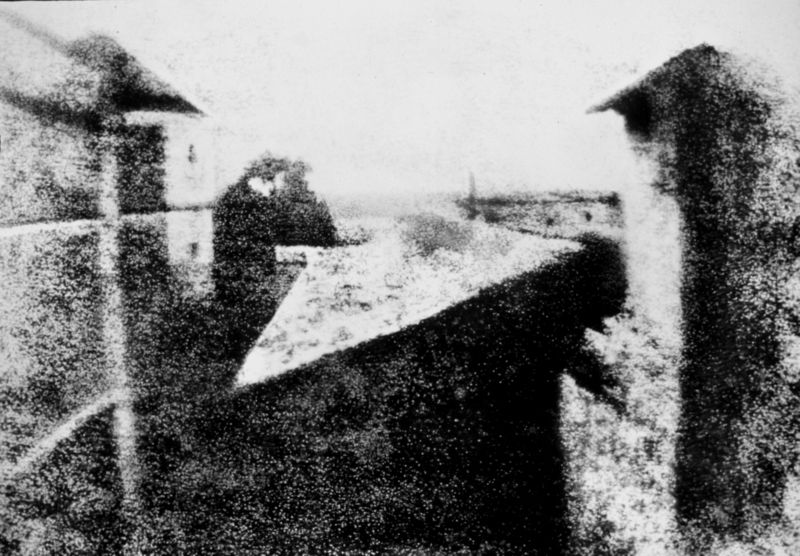
The above image, captured by French inventor Nicéphore Niépce in 1825 and titled 'View from the Window at Le Gras' is commonly regarded as the first photo ever taken and, coincidentally enough, was published in Roland Barthes' (yes, the very same) book Camera Lucida. What the photo allegedly depicts is an outside table being set for the evening meal, but what it shows more importantly is the beginning of a new and now viral manner of recording events, places and people: photography. In many ways you could argue that the recorded image has always been the enemy of writing: whilst photos haven't come to replace the written word per se, they've certainly enhanced our enjoyment and understanding of countless stories and texts: from the likes of the illustrated story books that we were read as children, to the textbooks we hurriedly digest with hungry brains before exams.
But to this day no method of recording information, has proved as efficient and versatile as the written word.
Just as Barthe's argues that a text can exist happily without the author, it could be said that a picture – like the one above – speaks for itself without the need for an accompanying caption (although in this instance it certainly helps). With the widespread ownership of a plethora of electronic devices you would have thought we could all but leave written text behind, opting instead to communicate through the spoken word or visuals alone whilst recording every choice event as pictures and videos. And yet, at times we still choose the text message over the phone-call and record events in writing rather than sound or video (much like this blog).
Writing clearly has a practical place of its own before you even begin to consider it on purely artistic merit and this ingrained association of the written word as art in itself has become so obvious as to be abused. I'm sure not half the Fifty Shades enthusiasts would confess to being a fan of an adult movie by the same name, but the fact that E.L. James wrote a smutty book instead of a film has given the series a disconcerting level of success it may (or arguably, should) never otherwise have known.
